Learning Outcomes:
i. Students will understand the concept of the acceleration due to gravity ('g') and its relationship to the mass of the gravitational source and the distance from the source.
ii. Students will learn that 'g' decreases with increasing altitude from the surface of Earth due to the inverse square relationship between gravitational force and distance.
iii. Students will be able to calculate the value of 'g' at different altitudes using the formula g = GM/R².
iv. Students will appreciate the implications of the variation of 'g' in various applications, such as satellite motion and high-altitude experiments.
Introduction:
In our everyday lives, we often take the force of gravity for granted. We experience it pulling us towards the Earth, causing objects to fall, and keeping us anchored to the ground. But what happens when we venture away from the Earth's surface, towards the vast expanse of space? Does gravity still hold its sway, or does it diminish? This lesson delves into the fascinating world of 'g', the acceleration due to gravity, and its intriguing variation with altitude.
i. Understanding 'g':
The acceleration due to gravity ('g') is a measure of the gravitational force acting on an object. It is defined as the force per unit mass, and its value depends on the mass of the gravitational source and the distance from the source. The formula for calculating 'g' is:
g = GM/R²
where:
- g is the acceleration due to gravity (m/s²)
- G is the universal gravitational constant (6.674 × 10^-11 N·m²/kg²)
- M is the mass of the gravitational source (kg)
- R is the distance from the center of the gravitational source (m)
ii. Variation of 'g' with Altitude:
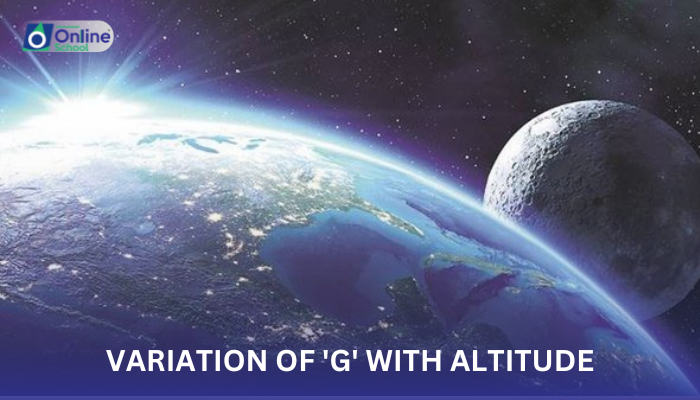
The Earth, being a massive sphere, exerts a gravitational force on objects near its surface. This force is what we experience as gravity. However, as we move away from the Earth's surface, the distance from the center of mass increases, and the gravitational force decreases. This decrease in gravitational force results in a corresponding decrease in the acceleration due to gravity, or 'g'.
iii. Significance of Variation in 'g':
The variation of 'g' with altitude has significant implications in various fields:
Satellite Motion: Satellites orbiting the Earth experience a slightly weaker gravitational force due to their higher altitude. This reduced force is what keeps them in their orbits around the Earth.
High-Altitude Experiments: Scientists conducting experiments in high-altitude balloons or space stations need to account for the reduced gravitational force, as it can affect the behavior of materials and experiments.
Geophysics: Understanding the variation of 'g' with altitude is crucial in studying the Earth's internal structure and variations in its mass distribution.
The acceleration due to gravity, 'g', is not a constant value; it changes with altitude. This variation is due to the inverse square relationship between gravitational force and distance. Understanding this relationship is essential for various scientific and technological applications, including satellite motion, high-altitude experiments, and geophysical studies. By comprehending the intricacies of gravity's reach, students gain a deeper appreciation of the forces that govern our world and the vastness of the universe.
